

Phonics
Phonics
Phonics
Phonics
Math
Math
Math
Science
Science
Math
Math

Activities
Activities

Activities
Alphabets

Busy Books
Rhymes
Rhymes

Comprehension
Emotional Intelligence
Emotional Development
Emotional Development
The Solar System is one of the most fascinating and complex creations of the universe. It is our cosmic home, the place where Earth, the Sun, planets, moons, asteroids, and countless other objects interact in a beautiful shape governed by gravity. Understanding solar system is always a part of curiosity, whether you are a teacher, student or an astronomer! In this article we will learn few lesser known facts about our solar system.
Have you every looked up at the night sky? Kids often ask us millions of questions about space. You can use this lesson to teach the about our Solar System.
In a night sky we see many stars. And their distance to very far from us.
Some stars shine bright, while some are small and dim. And if we observe more, we see that some twinkle while some do not. The sun and moon can be seen clearly because they are closer to earth.
What is our Solar System Made of?
1. Our beautiful Solar System begins with Sun
At the center of our Solar System lies the Sun, a glowing ball of hot plasma and the source of almost all energy that supports life on Earth.
Key Facts About the Sun
- It makes up 99.86% of the total mass of the Solar System.
- Temperature at the core: 15 million°C.
- Surface temperature: 5,500°C.
- Age: 4.6 billion years.
- It is a medium-sized yellow dwarf star (G-type star).
- Light takes approximately 8 minutes and 20 seconds to reach Earth.
Without the Sun, no planet would have stable orbits, no climate would exist, and life as we know it would be impossible. The Sun’s powerful gravity keeps all planets and objects bound in orbit, creating a stable system.
We often think the Sun is “burning,” but it’s not fire.
The Sun produces heat through nuclear fusion, where hydrogen atoms combine to form helium—releasing massive energy.
2.The Sun is made of 73% hydrogen and 25% helium
The remaining 2% consists of:
- Oxygen
- Carbon
- Neon
- Iron
These elements come from earlier generations of stars. The means that- the Sun is made from the recycled material of older stars that lived and died before our Solar System was born.
Located at the center, sun's gravitational pull results into planets revolving around it.
Let me explain in detail-
Stars live, die, and explode
Long before our Sun existed, other stars were born in the universe.
These old stars:
- Lived for millions or billions of years
- Burned hydrogen and formed heavier elements like carbon, oxygen, neon, iron
- Eventually exploded as supernovae
When a star explodes, it throws its material into space like a cosmic firework.
The space around becomes full of stardust
After these explosions, the surrounding space filled with:
- Dust
- Gas
- Heavy elements (carbon, oxygen, iron, etc.)
- Particles created during the star's life
This mixture of particles is called stardust.
3. Our Sun was born from this recycled stardust
About 4.6 billion years ago, a huge cloud of this old stardust collapsed due to gravity and formed:
- The Sun
- Planets
- Moons
- Asteroids
So the Sun’s hydrogen and helium came from the early universe, but the heavier elements (oxygen, carbon, neon, iron) came from older stars.
Why this is important
It tells us that:
- The Sun is part of the cosmic recycling process
- Many elements on Earth (including those in your body) originally came from ancient stars
- You are literally made of stardust
As astronomer Carl Sagan said:
“We are made of star stuff.”
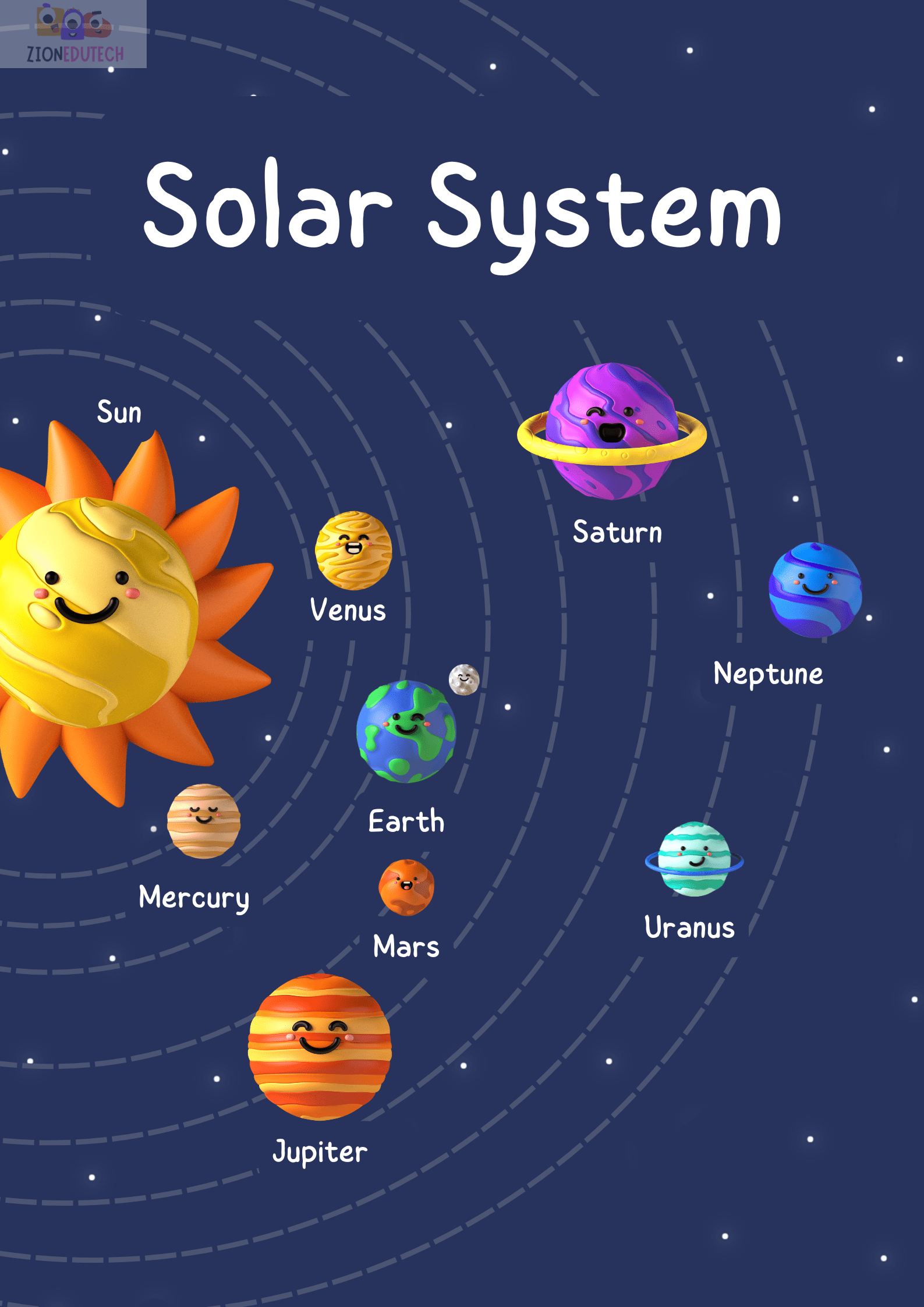
To remember the names of planets in their order from sun that is start from sun you can memorize this line- MY VERY EDUCATED MOTHER JUST SERVED US NINE PICKLES
Here M stands for Mars.
VERY V Stands for Venus
EDUCATED E Stands for Earth
MOTHER M Stands for Mercury
JUST J Stands for Jupiter
SERVED S STANDS FOR SATURN
PICKLE P STANDS FOR PLUTO
However Pluto has been removed from the list of planets and is included as a dwarf planet.
Four planets—Jupiter through Neptune—have rings.
Mercury and Venus do not have rings.
The Sun – The Center of Solar System
Sun is the largest object in our solar system. It makes up about 99% mass of our solar system. Sun is a huge ball of hydrogen and helium gases.
Why Sun is important to us?
Sun gives us light and heat energy so that we can live.
Sun is so huge that it can fit 1.3 million earrths inside it!
4.The Planets of the Solar System
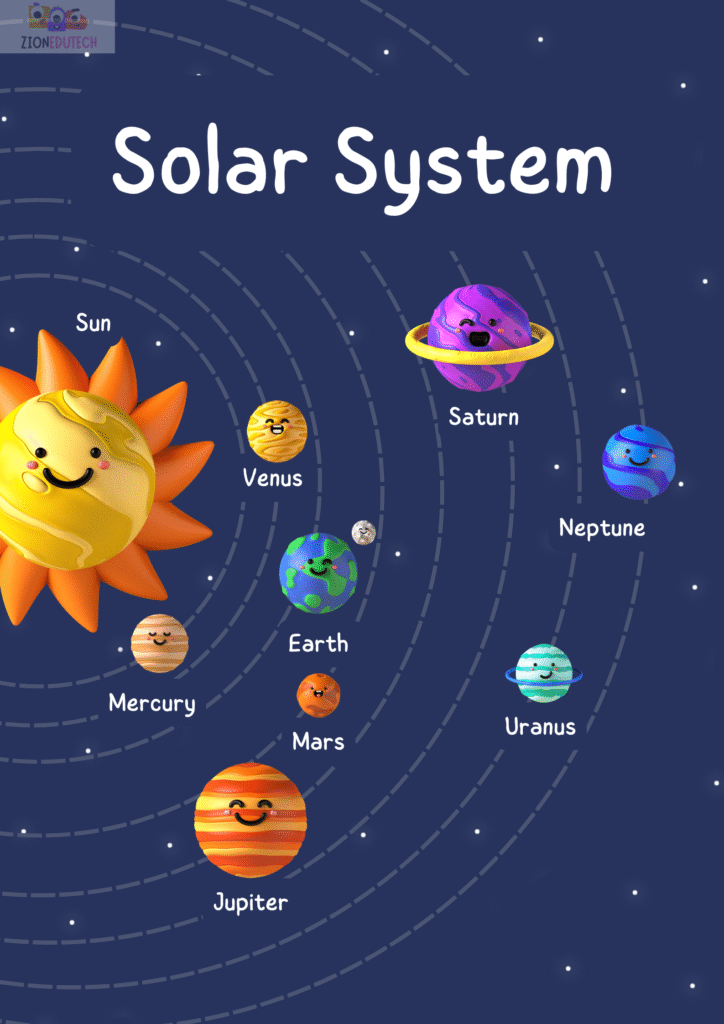
We have Eight planets in our solar system. They are main divided into two groups- inner groups and out groups.
1. Inner Planets Also called as rocky planets
Inner planets are mostly close to sun and mainly made up of metals and rocks
Mercury
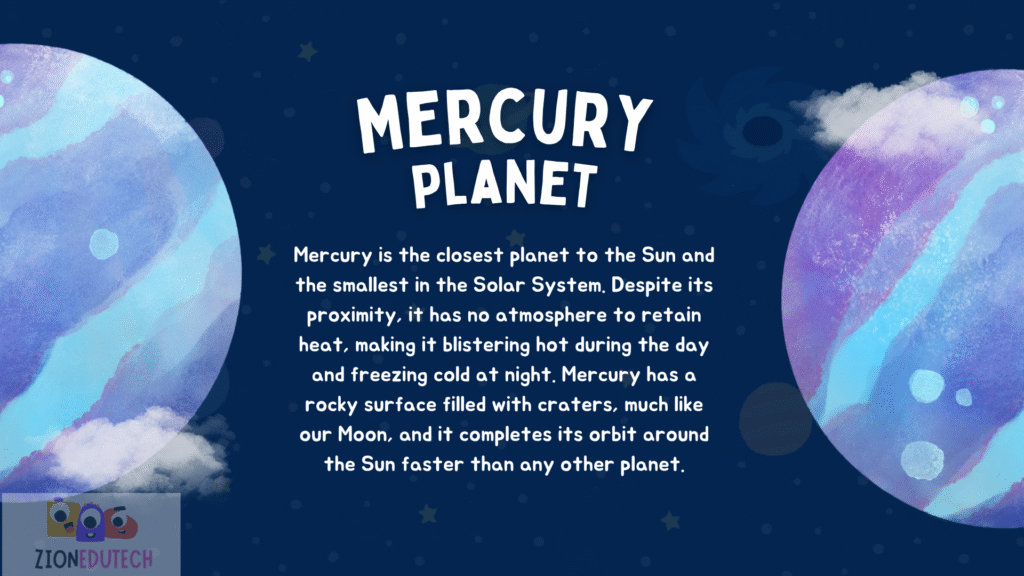
- Mercury planet is smallest and closet to earth. It has no atmosphere to retain heat. Mercury has very hot days and cold nights. It completes it's orbit around sun faster than any other planet.
- Closest planet to the Sun.
- Smallest planet in the Solar System.
- No atmosphere → extreme temperature changes.
- A year on Mercury = 88 Earth days.
- Mercury has water ice inside deep craters despite being close to the Sun.
Venus
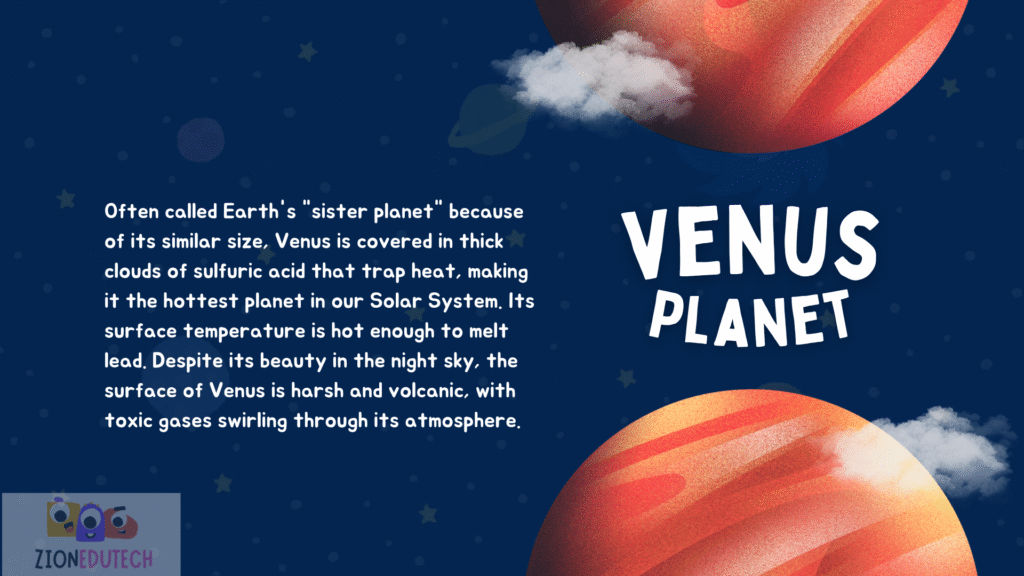
- Venus is called sister of Earth, because of it's similar size. Venus is covered in thick clouds of sulfuric acid that trap heat, making it the hottest planet.
- Similar size to Earth but extremely hot.
- Thick atmosphere of carbon dioxide → runaway greenhouse effect.
- Hottest planet: 464°C surface temperature.
- Rotates backwards (retrograde rotation).
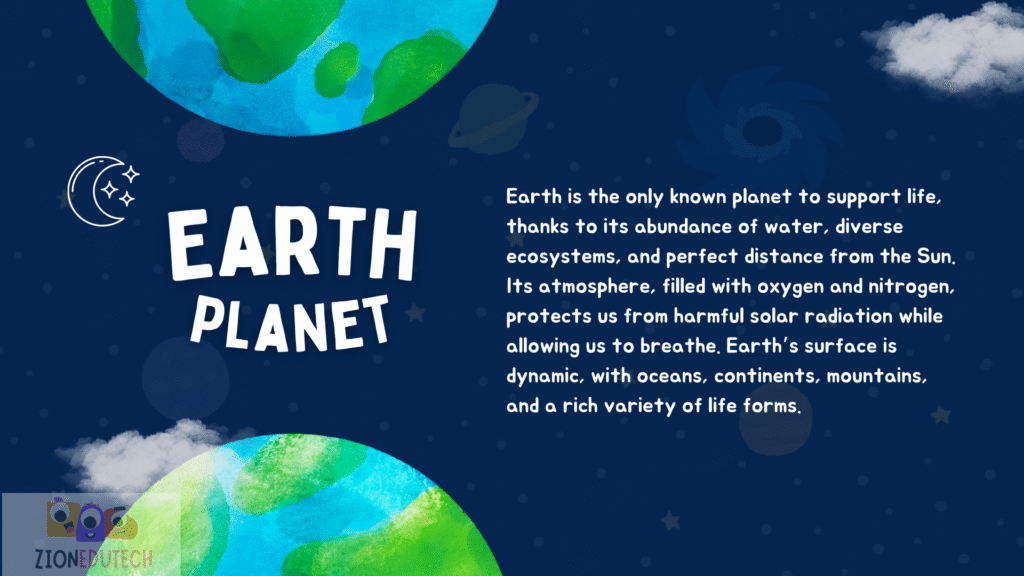
- Earth – Earth is the only planet that supports life. Earth has large amounts of water and ecosystems and it is at perfect distance from the sun.
- The only known planet that supports life.
- 71% of the surface is covered with water.
- Protected by a magnetic field and atmosphere.
- Has one natural satellite: the Moon.
2.Outer Planets (Gas Giants + Ice Giants)
Mars
- Known as the Red Planet because of iron oxide.
- Has the largest volcano: Olympus Mons.
- Thin atmosphere → extremely cold.
- Evidence of ancient water flows and rivers.
Jupiter
- Largest planet in the Solar System.
- Mostly hydrogen and helium.
- Has a giant storm: the Great Red Spot, active for 300+ years.
- Over 95 confirmed moons.
Saturn
- Famous for its spectacular ring system made of ice and rock.
- Second largest planet.
- Has more than 140 moons including Titan.
Uranus
- An “ice giant” made of water, ammonia, and methane.
- Rotates on its side (98-degree tilt).
- Pale blue because of methane gas.
Neptune
- Farthest known planet.
- Strongest winds in the Solar System: 2,100 km/h.
- Deep blue appearance due to methane.
Characteristics of Outer Planets
✔️ 1. Huge in size (giant planets)
Much bigger than inner planets.
✔️ 2. Made mostly of gases or ices
- Jupiter & Saturn → Gas giants (hydrogen + helium)
- Uranus & Neptune → Ice giants (water, methane, ammonia)
✔️ 3. Very cold
They receive little sunlight.
✔️ 4. Have many moons
Jupiter and Saturn have dozens of moons.
✔️ 5. Have ring systems
All four outer planets have rings (not only Saturn).
✔️ 6. Longer orbits (longer years)
Because they are far from the Sun, they take many Earth-years to complete one revolution.
5.Dwarf Planets: More Than Just Pluto
Pluto was once considered the ninth planet but was reclassified as a dwarf planet in 2006.
There are currently five officially recognized dwarf planets:
- Pluto
- Eris
- Haumea
- Makemake
- Ceres
Pluto Facts
- Located in the Kuiper Belt.
- Has five moons (largest: Charon).
- Surface has ice mountains, valleys, and nitrogen plains
Common Terms of Astronomy:
Stars:
Those that twinkle in the sky are called stars. Stars are heavenly bodies. They have their own light. Sun is also a star because it has it's own light.
All planets in our solar system revolve around the sun. They follow a specific path while revolving. This path is called orbit. Other than planets there are other heavenly bodies as well.
Satellites:
Heavenly bodies that revolve around the planets are called satellites. Satellites get their light from the sun. Have you seen moon at night? Moon is also a satellite. It revolves around the earth.
Planets:
The heavenly bodies that do not twinkle are called planets. Also they revolve around the sun. Hence they are called planets. Planets do not have their own light. They get their light from the sun. Planets revolve and rotate.
Our Solar System :
Our Earth is also a planet. It gets it's light from. It revolves around the sun. It's movement around the sun is called revolution. One revolution if earth equals to one earth year.
Besides earth there are seven other planets. They are Mercury, Venus, Jupiter, Mars, Saturn, Uranus and Neptune.
Dwarf Planets:
These are some small heavenly bodies that revolve around the sun. They are called Dwarf Planets. Pluto, a very well know dwarf planet, also revolve around the sun, however it has its own independent orbit.
Asteroids:
Between plants Mars and Jupiter there are several smaller bodies. These are Asteroids, Asteroids also revolve around the sun.
Other heavenly bodies are much smaller in size.
Our solar system has hundreds of moons, many asteroids, planets and stars. Our Solar system is bonded by gravity.
The Sun, Moon, Stars were always visible to the naked eyes of human. Hence ancient astronomers observed them. They invented telescopes to study them.
Today we have lots of information on how these heavenly bodies move, how far they are, what they are made up of and their properties. Yet we haven't been able to reach everything in the universe. There are still many galaxies, planets and stars that we haven't explored.
All this information is scrutinized in attempts to understand in detail the origin and evolution of the solar system—a goal toward which astronomers continue to make great strides.
Get Free Solar System Presentation!
Don't miss out on Editable Format and infinite books!
Phonics
Phonics
Phonics
Phonics
Math
Math
Math
Science
Science
Math
Math
Activities
Activities
Activities
Alphabets
Busy Books
Rhymes
Rhymes
Comprehension
Emotional Intelligence
Emotional Development